November is Restorative Practices Month
Restorative Practices (RP) are often associated with student discipline, but their principles are equally transformative when applied to teachers and staff. At its core, RP focuses on building strong relationships, fostering open communication, and creating a culture of care.
In observance of Restorative Practices Month, we share tips and resources to help foster an environment where all staff feels supported, valued, and connected.
Tips for Supporting Staff using RP:
- Create Spaces for Dialogue and Support: Restorative circles can be adapted to provide a structured, non-judgmental space for staff to share their experiences, frustrations, and emotional burdens. Schools that use restorative circles for staff report higher levels of trust, improved collegial relationships, and a stronger sense of community.
- Build Connection and Purpose: Restorative approaches emphasize relational teaching, encouraging educators to build stronger connections through open dialogue, empathy, and mutual respect. When staff feels valued and appreciated, their sense of fulfillment increases. Staff who work in schools with strong restorative cultures report feeling less stressed by behavioral issues, as they have meaningful tools to address conflicts and foster a positive classroom environment.
- Transform School Culture for the Adults, Too: A school that adopts restorative principles fosters a culture where everyone, not just students, feels valued and supported. When staff are given the same level of care and attention as students, they are more likely to remain engaged and passionate about their work. Implement RP for educators by integrating them into school policy, shifting from a top-down approach to one that actively involves staff in decision-making processes for policies, discipline, and professional development.
Additional Resources:
- Building a Culture of Staff Wellness Through MTSS: Recommendations from the Center on PBIS on using the MTSS framework to prioritize staff health and well-being.
- Self-Care Guide for Teachers: A resource emphasizing that healthy and happy teachers benefit the entire classroom and reduce risk of burnout.
- Build Positive Relationships to Boost Productivity: Strategies from the National Wellness Institute for how staff can build positive relationships to increase happiness and effectiveness.
Spotlight on Vineyard Elementary School

Over the past two years, Vineyard Elementary School has made Restorative Practices a cornerstone of its daily culture, beginning with comprehensive training for leaders and staff provided through SLOCOE.
Since then, all staff members have received training in community-building circles. Every teacher now leads a daily “Morning Meeting,” a community-building circle designed to strengthen classroom relationships and set a positive tone for the day. These meetings are tailored to their student needs – often starting with something lighthearted before guiding discussions on character traits and encouraging students to share concrete ways to demonstrate that quality throughout the day.
Each classroom also maintains a “problem jar,” where students can confidentially submit concerns or challenges. Teachers use these notes to determine whether a special circle is needed to address a particular issue, such as student frustrations over certain behaviors, allowing the class to develop solutions together. Championing these efforts are third-grade teacher Susie Acheatal, who runs an additional circle about once a week, and fifth-grade teacher Laura Kladifko, who frequently models circle facilitation and offers support to colleagues.
Another key restorative strategy used schoolwide is the incorporation of affective statements and questions. All teaching staff use these questions to guide students in reflecting on the impact of their actions, leading to more effective and empathetic responses to undesired behavior.
By embedding Restorative Practices within its multi-tiered system of support, Vineyard Elementary has strengthened its school culture, improved communication, and created a more positive and connected community for students and staff alike. Thank you for leading the way!
Training Opportunity
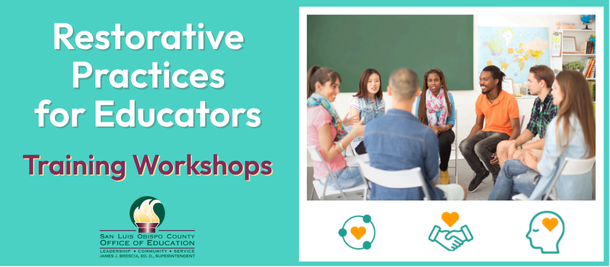
SLOCOE is offering two opportunities for educators to receive training in implementing Restorative Practices. This 2-day training workshop will equip participants with a variety of strategies to build community, foster healthy relationships, and develop a true sense of belonging. Restorative Practices support the well-being of students and staff alike, so we encourage all educators to register.
Two workshops are available:
January 21 and 22, 2026 – Register Here
April 28 and 29, 2025 – Register Here